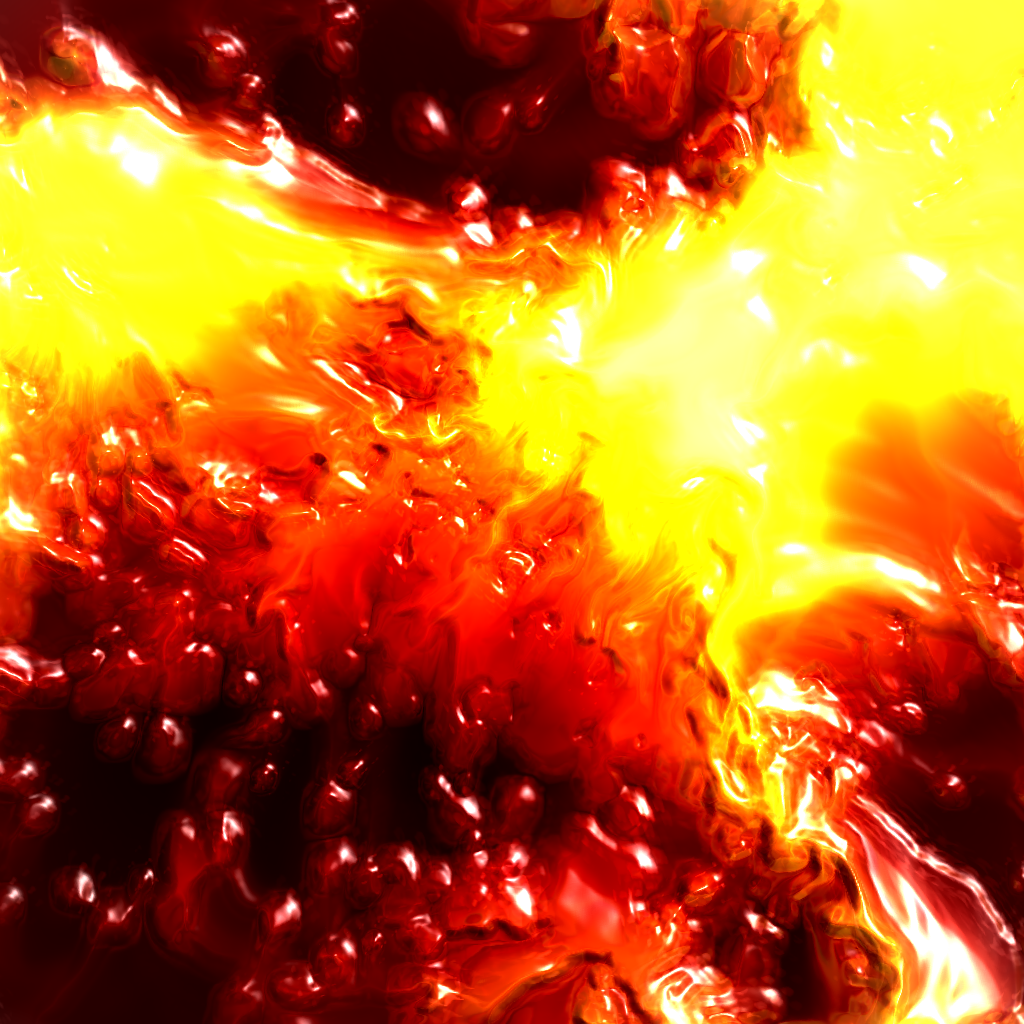
Noisemaker for TouchDesigner: TOP network at 1024×1024, frame at 30 seconds
Download the .toe
42 KB · single file
- TouchDesigner
- 2025.32820 or newer
- License
- free Non-Commercial (1024×1024 is within its resolution limit)
- Python
- not needed (the shaders are in the network)
- Open the
.toe. The network is prebuilt. - The simulation starts empty. After about 30 seconds at 60 fps, it reaches the state shown in the image above.
- Each effect is a GLSL TOP with its shader in a Text DAT.
The free Non-Commercial license requires a one-time activation with a Derivative
account on first launch.
This render is not pixel-identical to the other ports. The program feeds about 1M particles into a fluid simulation. TouchDesigner rasterizes points natively, and the reference implementation uses ANGLE. Point rasterization differs slightly between implementations, and the simulation amplifies these differences. Both results are correct. See the adapter's
This render is not pixel-identical to the other ports. The program feeds about 1M particles into a fluid simulation. TouchDesigner rasterizes points natively, and the reference implementation uses ANGLE. Point rasterization differs slightly between implementations, and the simulation amplifies these differences. Both results are correct. See the adapter's
docs/CHAOS-GATE.md.